

Search results
11/11/2020

На 11ти Ноември 2020 година од 13:00 часот, во организација на Blockchain Macedonia ќе се одржи вебинар на тема „Bloxberg - Blockchain for Science“ во рамките на кој свое излагање ќе има проф. д-р Слободан Калајџиски од ФИНКИ, претставник од нашиот факултет во Bloxberg конзорциумот.
Bloxberg инфраструктурата е сигурен јавен блокчејн формиран на почетокот од 2019 година од конзорциум составен од 11 светски научно-истражувачки институции од десет различни земји, а под водство на Макс Планк дигиталната библиотека. Целта на bloxberg инфраструктурата е да обезбеди децентрализирани сервиси за научниците, како и подобрување на соработката помеѓу глобалната научна заедница.
Агенда за вебинарот:
- Вовед
- Bloxberg blockchain и кориснички сценарија
- Bloxberg техничка инфраструктура
- Bloxberg валидатор
- Дискусија
Во прилог линк до вебинарот: https://zoom.us/j/96786277924
Настанот е во организација на групата Blockchain Macedonia.
1
02/10/2024

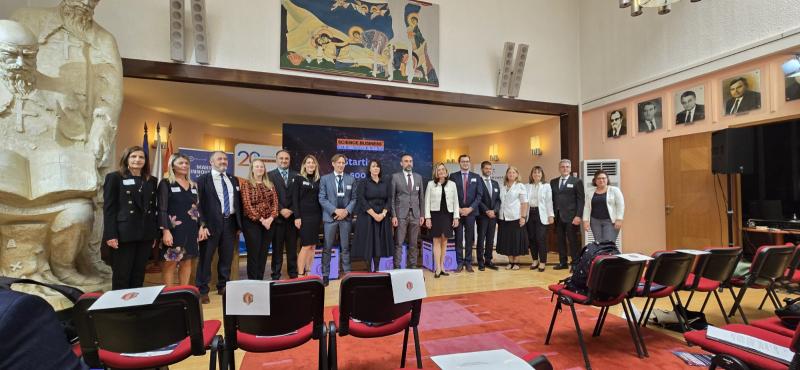
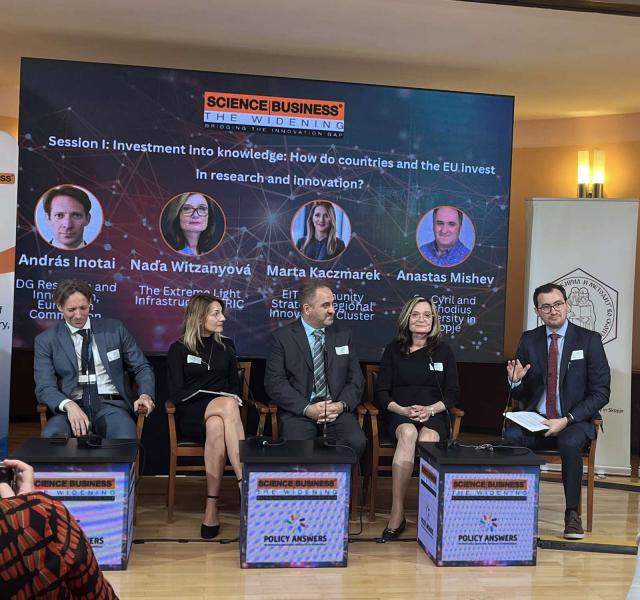
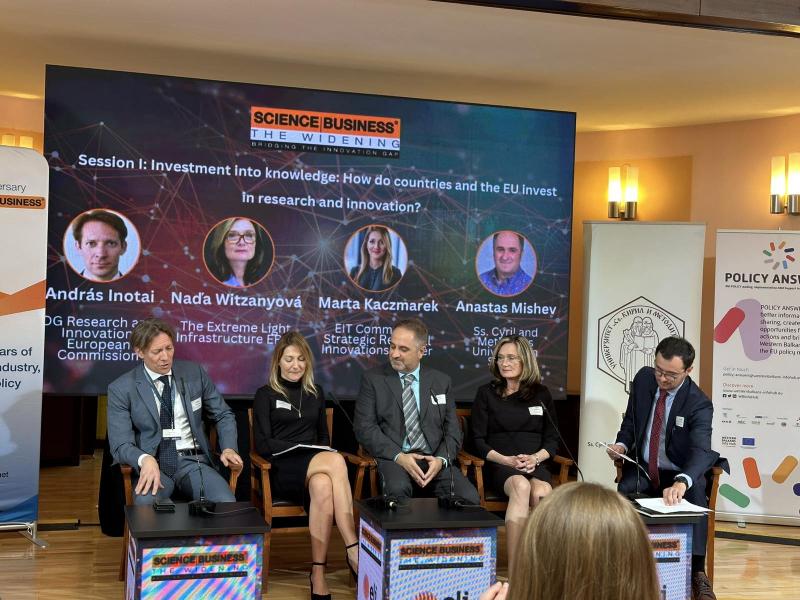
На 1 октомври 2024 година, Универзитетот „Св. Кирил и Методиј“ (УКИМ) беше домаќин на конференцијата Science|Business, која ја истакна важноста на интегрирањето на истражувачката инфраструктура на Западен Балкан во Европскиот истражувачки простор.
Конференцијата опфати дискусии за јакнење на капацитетите за истражување и иновации, создавање стратешки партнерства и спречување на „одливот на мозоци“. Покрај тоа, учесниците дебатираа за можностите на Југоисточна Европа да се поврзе со европската истражувачка мрежа.
Поддржана од Европската комисија и EIT Community, конференцијата обедини регионални и европски експерти.
На конференцијата учествуваше Д-р Анастас Мишев, редовен професор на ФИНКИ.
Конференцијата е прва од ваков вид, надвор од земјите на ЕУ.
1
Electrical engineering and computer science
07/11/2025

They presented the company and showcased examples of projects across various industries, technologies, and fields, including data science, machine learning, media and telecommunications, healthcare, the automotive industry and mobility, and modern banking.
In addition, they shared valuable insights into how their teams tackle real-world challenges, as well as information on career opportunities at HTEC—from entry-level to advanced positions, including internship programs.
The inspiring session, held in a laboratory branded with the company’s name and followed by in-depth, comprehensive discussions, was exceptionally motivating and important for students and young engineers. They demonstrated remarkable curiosity and a genuine desire to expand their knowledge and apply it in practice.
We are happy and grateful that HTEC is one of FCSE’s partners. We look forward to continued fruitful and successful collaboration, and to many more opportunities for development and advancement of our students, young engineers, and the Faculty as a whole.
1
Петар Ристевски
Submitted by martina.jankulovska on Mon, 05/10/2021 - 12:03Име и презиме:
Петар Ристевски
Наслов:
Microsoft Power Bi платформата и нејзината важност во Data Science
Датум:
Wednesday, May 12, 2021 - 14:30
Линк:
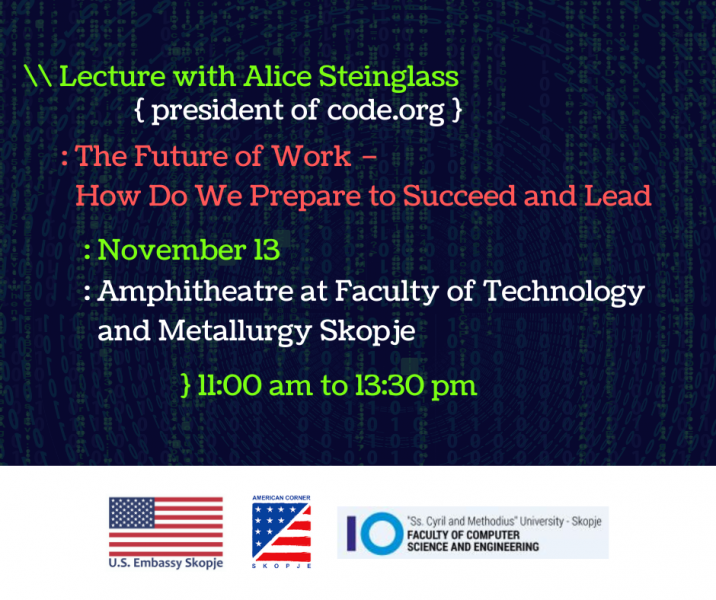
08/11/2019
Alice Steinglass is the president at Code.org, which makes the most broadly used curriculum for teaching computer science in primary and secondary schools. The curriculum is translated into over 25 languages and used by tens of millions of students and one million teachers around the world. In addition, her team partners with education and software companies across the industry to run the Hour of Code - a global movement that has reached 10% of the world's students.
Alice is dedicated to increasing diversity in computer science by giving every student the opportunity to learn computer science in school. With a student base that is 45% female, Code.org has already enrolled millions of girls in their Computer Science classes.
Prior to Code.org, Alice studied computer science at Harvard and led various teams at Microsoft: she managed the PM team for the UX Platform on HoloLens, designed APIs and developer client libraries for Xbox 360, ran an ecosystem outreach and UX team for Windows and built project management tools.
0
Linear algebra
Aim of the program:
To provide students in computer sciences with an basic knowledge of vectors and matrices and their application in the field of informatics. To learn the concepts and methods of linear algebra and how they can be applied in solving computational problems that arise in computer science. After passing the exam of this course the students should be able to perform standard operations on matrices, to solve and give interpretation of the solution of the system of linear equations, describe the main properties of finitely dimensional vector spaces and linear transformation and apply the method of linear algebra for modeling and solving problems in computer sciences.
Accreditation:

Security, cryptography and coding (4 + 1)
1. General Information
Postgraduate studies in Security, Cryptography and Coding aim at a top European education and training staff, which after graduation will be able to meet the needs of the industry.
- Name of the proposer: University "Ss. Cyril and Methodius University in Skopje, Faculty of Information Sciences and Computer Engineering - FINKI
- Name of the study program: academic second cycle studies in Security, cryptography and coding
- Scientific-research area: technical-technological sciences, natural-mathematical and sciences
- Field: Computer Science and Informatics, Informatics
- Area: Other ( Computer Security, Cryptography, and Coding)
- The value of postgraduate studies is 60 ECTS or 120 ECTS credits .
- Duration of studies: 2 or 4 semesters .
- One academic year consists of two semesters lasting 30 weeks (1 semester = 15 weeks).
- The first semester consists of subjects, while the second consists of subjects and the final project, ie. master thesis.
- Admission Requirements : Completed undergraduate studies in computer science or computer science with a minimum of 240 credits. For study directions that carry less than 240 credits, exams offered in the introductory layer are added.
- Introductory layer : Students who have earned less than 240 credits during their studies are offered a set of differential introductory courses. After their successful realization, the student acquires the right to continue with the second year of postgraduate studies.
- First semester: 3 Mandatory courses and 2 electives, one of which may be from the University list.
- Second semester: 1 Mandatory and 1 elective, which can be from the university list (only if in the first semester the subjects are selected at the Faculty level) and a final project of 18 ECTS
- 1 ECTS credit corresponds to 30 hours of total work engagement
- The number of contact hours is 4
- The academic title or degree obtained after graduation is
- Master in Information Science and Computer Engineering in the field of security, cryptography and coding
2. Studies
Table 3: List of Postgraduate Courses
| РБ | New Code / Subject | Semester | M / E | ECTS |
| 1 | BK-M-01 Advanced Information Security | IX | M | 6 |
| 2 | BK-M-02 Applied cryptography | IX | M | 6 |
| 3 | BK-M-03 Coding Theory | IX | M | 6 |
| 4 | Elective 2 | IX | E | 6 |
| 5 | Elective 2 | IX | E | 6 |
| 6 | BK-M-04 Computer Security | X | M | 6 |
| 7 | Elective course 3 | X | E | 6 |
| 8 | Master Thesis | X | M | 18 |
When choosing the courses, at least one elective course should be chosen from the offered elective courses in Table 4. The remaining elective courses can be selected from courses offered in all directions of the second cycle of studies at the Faculty of Information Sciences and Computer Engineering, and one of the electives can be chosen from the University list of courses of the second cycle of studies.
Table 4: Electives
< <
| РБ | New code / Subject | Semester | ECTS | Fund hours П | В |
|
| 1 | BK-E-01 Security for mobile and web applications | X | 6 | 30 30 | |
| 2 | BK-E-02 Biometric systems | IX | 6 | 30 30 | |
| 3 | BK-E-03 Provable security | X | 6 | 30 30 | |
| 4 | BK-E-04 Cryptanalysis | X | 6 | 30 30 | |
| 5 | BK-E-05 Cryptographic Engineering | IX | 6 | 30 30 | |
| 6 | BK-E-06 Cryptographic Protocols | X | 6 | 30 30 | |
| 7 | BK-E-07 Mathematical Logic for Computer Science | IX | 6 | 30 30 | |
| 8 | BK-E-08 Advanced Algebraic Structures | X | 6 | 30 30 | |
| 9 | BK-E-09 Advanced communication channel coding algorithms | X | 6 | 30 30 | |
| 10 | BK-E-10 Applied Information Theory | IX | 6 | 30 30 | |
| 11 | BK-E-11 Stochastic Processes | IX | 6 | 30 30 | |
| 12 | BK-E-12 Change and Risk Management | IX | 6 | 30 30 | |
| Selection from University List of Free Courses | 6 | 30 30 | |||
The student can choose a subject from the list of offered elective courses from all study programs of the second cycle of studies. The list of offered electives can be found on this link .
Security, cryptography and coding (3+1+1)
1. General Information
Postgraduate studies in Security, Cryptography and Coding aim at a top European education and training staff, which after graduation will be able to meet the needs of the industry.
- Name of the proposer: University "Ss. Cyril and Methodius University in Skopje, Faculty of Information Sciences and Computer Engineering - FINKI
- Name of the study program: academic second cycle studies in Security, cryptography and coding
- Scientific-research area: technical-technological sciences, natural-mathematical and sciences
- Field: Computer Science and Informatics, Informatics
- Area: Other ( Computer Security, Cryptography, and Coding)
- The value of postgraduate studies is 60 ECTS or 120 ECTS credits .
- Duration of studies: 2 or 4 semesters .
- One academic year consists of two semesters lasting 30 weeks (1 semester = 15 weeks).
- The first semester consists of subjects, while the second consists of subjects and the final project, ie. master thesis.
- Admission Requirements : Completed undergraduate studies in computer science or computer science with a minimum of 240 credits. For study directions that carry less than 240 credits, exams offered in the introductory layer are added.
- Introductory layer : Students who have earned less than 240 credits during their studies are offered a set of differential introductory courses. After their successful realization, the student acquires the right to continue with the second year of postgraduate studies.
- First semester: 3 mandatorycourses and 2 electives, one of which may be from the University list.
- Second semester: 1 mandatoryand 1 elective, which can be from the university list (only if in the first semester the subjects are selected at the Faculty level) and a final project of 18 ECTS
- 1 ECTS credit corresponds to 30 hours of total work engagement
- The number of contact hours is 4
- The academic title or degree obtained after graduation is
- Master in Information Science and Computer Engineering in the field of security, cryptography and coding
2. Introductory layer
The introductory layer is intended for students who study for less than four years or have earned less than 240 credits from previous studies. The candidate should choose 4 courses from the proposed list, while the other 5 courses can be selected from the other courses offered at the faculty and one of the courses from the university list. If it happens that the candidate has already passed 7 or more of the recommended courses, then he has the right to choose a course from the other courses offered at the faculty.
Table 1: List of introductory layer items
| РБ | Subject | Semester | ECTS |
| 1 | mandatory subject 1 of Table 2 | VII | 6 |
| 2 | mandatory subject 2 of Table 2 | VII | 6 |
| 3 | mandatory subject 3 of Table 2 | VIII | 6 |
| 4 | mandatory subject 4 of Table 2 | VIII | 6 |
| 5 | Elective course 1 | VIII | 6 |
| 6 | Elective 2 | VIII | 6 |
| 7 | Elective course 3 | VII | 6 |
| 8 | Elective 4 | VII | 6 |
| 9 | Elective 5 | VIII | 6 |
| 10 | Selection from the university list of free courses | VII | 6 |
Elective courses can be selected from the proposed list of courses of the study program, Table 2, or from the proposed lists of courses from the introductory layer of other study programs of the Faculty of Information Sciences and Computer Engineering. The choice of courses should be made in accordance with the previous knowledge of the candidate and the necessary knowledge to continue with the postgraduate studies in Internet technologies. Only one free choice of subject is allowed which is on the university list of subjects for the first year of two-year postgraduate studies.
Table 2: List of electives
| РБ | New Code / Subject | Semester | ECTS | Prerequisite | |
| 1 | CSEW516 Cryptography | VII | 6 | Discrete Mathematics 2 | |
| 2 | CSES602 Computer Systems Security | VIII | 6 | Operating Systems | |
| 3 | CSEW303 Probability and Statistics | VII | 6 | Calculus 1 (Mathematics 1), Discrete Mathematics 2 | |
| 4 | CSES404 Information Theory with Digital Communications | VIII | 6 | Probability and Statistics | |
| 5 | CSEW702 Web based systems | VII | 6 | no | |
| 6 | CSEW515 Computer Ethics | VIII | 6 | realized a minimum of 90 ECTS credits | |
| 7 | CSEW703 Introduction to Pattern Recognition | VII | 6 | Artificial Intelligence | |
| 8 | CSES618 Network Security | VIII | 6 | Data and Computer Communications, Operating Systems | |
| 9 | CSES405 Wireless & Multimedia Systems | VIII | 6 | Data Computer Communications | |
| 10 | CSES620 Non-relational databases | VIII | 6 | Databases | |
After the successful completion of all ten courses and 60 credits, the student with previously acquired 180 ECTS credits (or completed three-year studies) continues with the courses from the second academic year of postgraduate studies - Table 3 (IX and X semester). p>
3. Studies
Table 3: List of Postgraduate Courses
| РБ | New Code / Subject | Semester | З / И | ECTS |
| 1 | BK-Z-01 Advanced Information Security | IX | З | 6 |
| 2 | BK-Z-02 Applied cryptography | IX | З | 6 |
| 3 | BK-Z-03 Coding Theory | IX | З | 6 |
| 4 | Elective 2 | IX | И | 6 |
| 5 | Elective 2 | IX | И | 6 |
| 6 | BK-Z-04 Computer Security | X | З | 6 |
| 7 | Elective course 3 | X | И | 6 |
| 8 | Master Thesis | X | З | 18 |
When choosing the courses, at least one elective course should be chosen from the offered elective courses in Table 4. The remaining elective courses can be selected from courses offered in all directions of the second cycle of studies at the Faculty of Information Sciences and Computer Engineering, and one of the electives can be chosen from the University list of courses of the second cycle of studies.
Table 4: Electives
| РБ | New code / Subject | Semester | ЕКТС | Fund hours П | В |
|
| 1 | BK-I-01 Security for mobile and web applications | X | 6 | 30 30 | |
| 2 | BK-I-02 Biometric systems | IX | 6 | 30 30 | |
| 3 | БК-И-03 Provable security | X | 6 | 30 30 | |
| 4 | БК-И-04 Cryptanalysis | X | 6 | 30 30 | |
| 5 | БК-И-05 Cryptographic Engineering | IX | 6 | 30 30 | |
| 6 | БК-И-06 Cryptographic Protocols | X | 6 | 30 30 | |
| 7 | БК-И-07 Mathematical Logic for Computer Science | IX | 6 | 30 30 | |
| 8 | БК-И-08 Advanced Algebraic Structures | X | 6 | 30 30 | |
| 9 | БК-И-09 Advanced communication channel coding algorithms | X | 6 | 30 30 | |
| 10 | БК-И-10 Applied Information Theory | IX | 6 | 30 30 | |
| 11 | БК-И-11 Stochastic Processes | IX | 6 | 30 30 | |
| 12 | БК-И-12 Change and Risk Management | IX | 6 | 30 30 | |
| Selection from University List of Free Courses | 6 | 30 30 | |||
The student can choose a subject from the list of offered elective courses from all study programs of the second cycle of studies. The list of offered electives can be found on this link .